Wednesday, June 17, 2015

Friday, June 21, 2013
West Virginia, Still Home
Yesterday, I came across this beautiful Op-Doc piece by Elaine McMillion for the New York Times:
http://www.nytimes.com/2013/06/20/opinion/west-virginia-still-home.html?_r=0
It touches a nerve for me and nearly had me in tears by the end of the 7 minutes. Like Elaine McMillion, I feel complicit in the exodus of young people from my home state and therefore complicit in West Virginia's mire. I left for college in 1999 and have only been back once or twice each year since to see family. I've lived in North Carolina, Wisconsin, Michigan and Vermont, yet West Virginia still feels most like home.
But I (and thousands of others) may never return there, for lack of opportunity. Why fight an uphill battle when life in Vermont affords me a similarly spectacular mountain landscape, a forward-minded community, and a satisfying job that simply doesn't exist there? Still, West Virginia tugs at my heart and heels, like a friend in need. Or family. I can't just turn my back on it. And in truth I'm deeply thankful my family is still rooted there, so I have plenty of cause to return.
It's a place to break your heart and in countless ways: its magnificent waves of blue mountains, the thickets of laurels and rhododendrons, the senseless self destruction of the coal industry and regressive politics. Beauty and destruction abound in this complicated place. And being not-there has been definitive for me.
Though I may not ever live there again, I often turn to poetry, much as McMillion (who lives in Boston but grew up in the coal country of southern WV) turns to documentary film and photography, in order to remain rooted to this place that will always be home. By the end of the summer, I'm aiming to have completed the manuscript for my first full-length collection (tentatively dubbed North Fork, South Branch) which centers on the complexity of Appalachia.
Here's an early poem, first published in Green Mountains Review:
In the Frame of Innings, Pendleton County, W.Va.
Remember it shin-deep, that coppery, sulphuric hue:
the North Fork of the South Branch –
the way it caught the summer glow
and threw it back to us tarnished?
We cruised those towns along the shallow ribbon:
Petersburg, Moorefield. Wampler farms. August heat.
The summer’s sweet promise grown over-ripe,
scudding away downstream where eagles once nested
in the high-eaved banks. Bruised stink of poultry on the air.
Our fathers’ work shirts crumpled on the bedroom floors
in a sweaty heap; twenty years old and nowhere to go.
Just get ahold of what you can and swing like hell, Dad said. D’ya hear me?
We were young men, old boys grown too old from work,
the Guard, the low empty skies of our homes.
Sundays we gathered at the ballpark by the swale,
at the edge of hairy cornfields, where crows swarmed
and the river’s dog-legged riffles kept the beers cold.
Filling into our bodies roughly, abundantly,
we were ready to put order to the green frenzy, our randy lives
with ball and bat, the smack of knuckles on leather palms,
the hey-nana-nana of pop and fling, gulping
our fleeting youth in the frame of innings.
Around there it all floats down the Potomac, on to Washington,
someplace else. The jobs, the college-bound, the new corridor
they had to run so many off to lay—a gash
in the ridgeline marks the route—
Eminent domain, the government called it.
Farm lines redrawn. Mountains thrust aside and scarred.
Big chugging trucks headed out of state. Loss arriving
in rehearsal for departure, hauling out the pieces.
So when someone like Travis Harper
could manage to rear back and uncoil
from some sweet sovereignty of motion
a slider that swept in from the knees
and bit the heart out of the plate, you bet
I dropped my shoulder, held my stare
and followed through with all I had.
It left me slack-jawed, glazed, then smiling.
What else to do but tip my hat
and marvel at that little bit of mastery?
—a moment of perfection amid
the sloppy, high-scoring hours of those days.
Afterwards, swerving down dirt roads,
throwing dust into the gleaming night,
we pressed the pedal home and since we could,
took one last swig of the high life before retiring.
Friday, June 7, 2013
To the Common Loon

After a weekend of paddling and camping on the Green River Reservoir, a true gem of a wild north-country lake, I've tried to cobble together years of impressions of the common loon into one small poem. The effort is indebted (perhaps too much) to John Haines and his very fine "Prayer to the Snowy Owl," which I've written about before on this blog.
To the Common Loon
Black-throated diver, you
arrive where I least expect you—
rising from the sweet marrow of the lake
within my own life.
You who split the air with eerie falsetto.
Weird yodeler of the quavering, tremulous cry
that makes the throes of joy
and pain indistinguishable.
Wolf-bird prowling the night country,
steward of sky-water,
artificer of True North,
swift gulper of those who dwell in darkness
Friday, May 17, 2013
Fight best in the shade of the cloud of arrows
I recently started reading the journals of Ralph Waldo Emerson and stumbled upon this gem, where Emerson claims that a person must do the work with that faculty he has now. But that faculty is the accumulation of past days. No rival can rival
backwards. What you have learned and done is safe and fruitful. Work and
learn in evil days, in insulted days, in days of debt and depression
and calamity. Fight best in the shade of the cloud of arrows.
Seems like an appropriate banner to carry these days as we rush toward global climate catastrophe amid other horrors. In Emerson's time slavery was the evil to overcome. We still have our work cut out for us. Keep fighting the good fight and doing the work that is real.
Seems like an appropriate banner to carry these days as we rush toward global climate catastrophe amid other horrors. In Emerson's time slavery was the evil to overcome. We still have our work cut out for us. Keep fighting the good fight and doing the work that is real.
Monday, February 11, 2013
Django Unchained
There's a Django Blowout at The Rumpus. Actually, it's been up for several weeks, which in the interwebs is equivalent to the T'ang Dynasty. But I was slow to get to the movies (the nearest theater is an hour away) to see Django and slower still in simmering a head full of thoughts about Tarantino's latest (and arguably greatest) film.
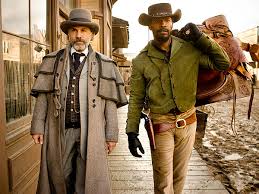 I'm fascinated by Django Unchained, captivated by the deft balancing act Tarantino pulls off
between the cartoonish over-the-top violence and the disturbing, painful
scenes that are almost unbearable. I am reminded of a phrase from Cormac MacCarthy’s Blood Meridian, which is:
“death hilarious” (which I believe owes its origins to the sharks
surrounding the Pequod in Moby-Dick). Anyway, there’s a sense throughout the film that Tarantino
wanted to make this film entertaining so that we are more inclined to
deal with the issues it brings up than if it were a brutally realistic portrayal.
It’s almost too easy to make a film like Schindler’s List, where it’s so realistic and so awful and so distancing for the viewer, where misery trumps entertainment and viewers go away feeling depressed. Or an historical "and then" dramatization wiped clean of grit. With Django, I found myself laughing, fist-pumping, flinching, gasping, on the verge of tears, on the edge of my seat….and it’s a film that I will watch again. Americans (all of us) need to examine the bloody, destructive, oppressive pillars on which our nation [empire] was constructed and continues to be [see drone wars, etc.]. Django is devilishly crafted to make us look at ourselves in a dark mirror of violence. And there’s just enough slick style and panache to go with the truly horrible to spur conversations and further viewing. Kudos to Tarantino.
****
I join Anisse Gross in applauding Tarantino’s risk-taking. And yes, it’s far from a perfect film. For instance, it’s definitely a problem that Broomhilda isn't developed into a real character but remains a voiceless figure. But I’m impressed that under the ultra-loud, in-your-face exaggeration of Django (a hall-mark of Tarantino’s style) there is also a "hive of subtlety” layered throughout the film. Much of this subtlety and subconsciousness is referenced by Ade Adeniji in Take #4 “Substance Amidst Spectacle.” Like the scene where the white sheriff welcomes Django into his cabin for birthday cake. Or when Django has to talk his way out of his rock-mine fate. His question to the Aussies, “Do I sound like a slave?” echoes out to Douglass and others who had to take on the twin burdens of proving their humanity (i.e. yes, I really wrote this book about my life) and also the burden of later proving—often on the lecture circuit—that they had indeed been enslaved (i.e. yes, these are scars upon my back).
The points of criticism I've heard all seem a bit tired. The use of language. The violence. The fact of a white man telling a story of slavery. The frustration that Django doesn't free his fellow slaves. The first two don't really merit commentary. The third is a failure of imagination and a discredit to empathy. And as for the last, critics who want Django to more of a Touissant L’Ouverture than a man on a mission are expecting too much and are forgetting the film works within the tropes of the Western. This can’t be THE film about slavery in America. (Besides… who knows what the freed Django and Broomhilda might do after leaving Candyland? And how many fellow slaves did Douglass free on his way out of Maryland?) I don’t find fault with the film for building it’s premise on the hero’s journey (to rescue his love) instead of on a grander rebellion scheme to free the millions in chains. We can only assess it for what it is, not what it isn't.
The role of Dr. King Schultz has been taken to task, too, but I think Tarantino addresses this well in part 3 of his interview with Henry Louis Gates (see http://www.theroot.com), where he dismisses the notion of Schultz as a White Savior:
QT: “…one of the tropes of Westerns and telling a story like this is you have an experienced gunfighter who meets the young cowpoke who has some mission that he has to accomplish, and it’s the old, experienced gunfighter who teaches him the tricks of the trade: teaches him how to draw his gun, teaches him how to kill.As with Melville’s novella Benito Cereno, (another contentious, misunderstood tale of slavery by an American original) the aim is both entertainment and soul-searching. Americans need to feel our complicity in the violence of slavery, and one way to do that is to try to make a film about such a brutal topic through stylized fantasy rather than historic realism. Thus that recognizable Tarantino coolness that leaves me feeling uncomfortable with how much I enjoyed the film and wanting to talk about it more, to go away and think about it all more. Ultimately, we need MORE works of art, film, literature, that examine slavery and from multiple angles. Django Unchained is a vibrant addition to this canon, and there is plenty of room for expansion.
“… Now, you go to the kung fu films — that’s always the case. There’s an older guy teaching the younger guy and sending him on a vengeance journey.”
“… I actually was hoping to get a little bit of narrative anxiety going on about halfway through the movie: Wait, is this just going to be Schultz doing everything? What’s going on here? Hopefully, if you’re unbiased, from where I’m coming from, it makes sense how the whole first part of the story’s going. But when is Django going to be the hero? Because truthfully, in the first half of the story, he is Schultz’s sidekick. But to me that’s OK.
HLG: But that’s an apprentice period.
QT: Exactly. It’s his origin issue of his comic book.”
Tarantino has the genre of the Western on his side. See also the Slave Narrative where, for example, Frederick Douglass has the likes of William LLoyd Garrison write a preface to his tale. This device is likely attributed to racist publishing practices or at least directed at racist readers who couldn’t believe a former slave could write such an eloquent tale. But I digress…in the content of the narrative itself, at least in the popular 1845 edition, Douglass attributes his escape to freedom to the assistance of several white sources, notably a white mistress and some Irish street kids in Baltimore who taught him to read and write.
Thursday, January 3, 2013
On Reviewing
A friend recently asked if I might write a review for him (he's reviews editor of a popular online journal), and I agreed, though I've never written a review in my life. You'd think we would have been required to do something like this in
poetry school before being deemed "Masters of the Fine Art," but no...Which made me confront a very basic issue: why DON'T I write (or read) reviews?
Partly it's that the few times I DID look at reviews (in the early 2000s, in Poetry), I was turned off by the snide, biting deconstructions I found. And also because when I think of all the new literature, art, music, and film I've come to love in recent years, it's come directly from friends, teachers, and colleagues with an eclectic array of tastes. As much as I admire a number of publications that run reviews and want to believe in the idea of the review, I hardly ever find myself discovering a book of poems or short story collection or novel because of them. In fact, I can't think of a single thing I've discovered or read because of a review.
As a result, perhaps I sometimes miss out on The Hot Thing Of The Moment, whatever is "trending," as they say. Though what's good enough to stick around in the cultural craw is usually still there years later when I manage to stumble upon it or have a friend place it under my nose (Pavement sounded as good to me in 2009 when my friend Adam introduced them to me as they must have in the '90s. Same with poet D.A. Powell who I've just started reading thanks to his VSC visit last year). Plus part of me is always thinking my god, I've not yet even read all of Nabokov! How could I possibly bother to read enough books that were published in 2012 to find something good or even create a Top 10 list?!? I digress....
What inspired me to think a bit differently came from an essay by William Matthews, who writes:
So I welcomed the assignment of writing a review and took my pick of recent titles I'd never heard of and scanned a few. One rule, I decided, is that--as with recommendation letters for former students--I cannot write a review of a book I feel less than enthusiastic about. I read a few reviews of recent poetry and fiction and thought about why I read poetry and came up with a rough outline for reviewing:
1. What is the thing before me? Describe it.
2. What does it seem to be doing/trying to do? Does it succeed in this effort?
3. Why would it be worth someone's time to read?
4. What do I have to say about it that someone hasn't already?
That's how I approached reading and reviewing the chapbook The Branches, the Axe, the Missing (Black Lawrence Press) by Charlotte Pence. You can find the review here.


Partly it's that the few times I DID look at reviews (in the early 2000s, in Poetry), I was turned off by the snide, biting deconstructions I found. And also because when I think of all the new literature, art, music, and film I've come to love in recent years, it's come directly from friends, teachers, and colleagues with an eclectic array of tastes. As much as I admire a number of publications that run reviews and want to believe in the idea of the review, I hardly ever find myself discovering a book of poems or short story collection or novel because of them. In fact, I can't think of a single thing I've discovered or read because of a review.
As a result, perhaps I sometimes miss out on The Hot Thing Of The Moment, whatever is "trending," as they say. Though what's good enough to stick around in the cultural craw is usually still there years later when I manage to stumble upon it or have a friend place it under my nose (Pavement sounded as good to me in 2009 when my friend Adam introduced them to me as they must have in the '90s. Same with poet D.A. Powell who I've just started reading thanks to his VSC visit last year). Plus part of me is always thinking my god, I've not yet even read all of Nabokov! How could I possibly bother to read enough books that were published in 2012 to find something good or even create a Top 10 list?!? I digress....
What inspired me to think a bit differently came from an essay by William Matthews, who writes:
He's appealing to our duty as "literary citizens," and though there's no small amount of egoism and slime hiding under under the banner of so-called artistic citizenship, I agree with what Matthews is saying here, for it's really about the same as what I always strive for as a reader--intelligent, responsible readership. Readership that is itself an active, creative force and a welcome collaboration with the writer.In the midst of such distractions [publications, prizes, grants, careers, the whole ego thing], one way to care for your share of the literary climate is to sit down with some poems, read them as intelligently and passionately as they and your own limits as a reader will allow, and to describe accurately to yourself your affections for and distrusts of those poems.
To do this in public is to write a review.
William Matthews, from New Hope for the Dead: Uncollected Matthews (Red Hen Press, 2010).
So I welcomed the assignment of writing a review and took my pick of recent titles I'd never heard of and scanned a few. One rule, I decided, is that--as with recommendation letters for former students--I cannot write a review of a book I feel less than enthusiastic about. I read a few reviews of recent poetry and fiction and thought about why I read poetry and came up with a rough outline for reviewing:
1. What is the thing before me? Describe it.
2. What does it seem to be doing/trying to do? Does it succeed in this effort?
3. Why would it be worth someone's time to read?
4. What do I have to say about it that someone hasn't already?
That's how I approached reading and reviewing the chapbook The Branches, the Axe, the Missing (Black Lawrence Press) by Charlotte Pence. You can find the review here.


January First
My friends Michael & Phoebe called me up New Year's Day with a shove: write a sonnet before the end of the day titled "January First" and use the following words:
feast
mellon
unscrew
umbrella
Old Dan Tucker
pinstripe
lullaby
Somehow I failed to work "umbrella" in there, but here's my attempt (influenced a bit by Gerald Stern, whose latest collection, In Beauty Bright, has been at my bedside all week)
January First
How when family or the flu
comes knocking
Humming a tune, say, Old Dan Tucker or Auld Lang Syne,
Pay no never mind. January
First comes and wipes its salty
Boots on your stoop, waltzing
through with lips puckered,
With visions of clementines,
smoked meats, melons,
Pineapples, pinstriped
candies, intent on unscrewing
Your last stopper in a
reckless holiday rejoinder feast.
But the mugs of cheer have
been drained, the pantry laid waste.
What’s a new year but old
snow made to look fresh
From wind drifts? Another
number to hang on the wall
Or a pink baby to slap on
the ass then bed down in a breath
Of lullabies. Nor could you
avoid or escape it if you wished.
Take a good-will draught of
winter chill. You’re likely hung-over.
Besides, we’ve cleaned the
fridge. It’s too late now to get your supper.
Thursday, December 13, 2012
It’s Ironic, Isn’t It? - In These Times
It’s Ironic, Isn’t It? - In These Times
Here's a smart, short essay from my pal Barrett Swanson (In These Times) in response to Christy Wampole's "How to Live Without Irony" piece (Nov. 17, 2012 New York Times).
Here's a smart, short essay from my pal Barrett Swanson (In These Times) in response to Christy Wampole's "How to Live Without Irony" piece (Nov. 17, 2012 New York Times).
Tuesday, December 4, 2012
Blackbirds piled on the ground
Another poem I started in January 2011 at the Vermont Studio Center that is now getting the light of day is "Painting," which is perversely (I think) being shared via the VSC Holiday card to all our friends, donors, alumni, etc. Nothing says Happy Holidays like a storm of dead blackbirds falling from the sky! Oh well...
Painting
I paint a
field of snow
and a man
standing in it.
That’s my
picture of solitude.
I paint a
red bird in flight above the man.
His head is
raised. I call that song.
If I paint
the bird black and then another
and another
until there are 5,000 blackbirds
piled on the
ground, it is the sinks.
Perhaps snow
covers all the blackbirds but two.
The man is
drifted over by white and blue.
Two birds
remain to share a black seed (once was bird)
in the snow
crust. What would you call that?
Black ice the driver didn't know was black ice
Good news after long slumber: The most excellent Forklift, Ohio will be publishing a poem, "Before the Word," sometime next year. It's a poem I started writing two winters ago when I was a resident at the Vermont Studio Center. It was probably "finished" last winter right before the Monsters of Poetry reading. Though I did change a line or two after talking about it with Srikanth Reddy this past summer. And it will appear in print sometime in 2013.
That seems about average for me with getting work out there. I am slow. And choosy. I only send work to the journals I read and treasure. It's a long process of getting a poem to the page in handwritten scrawl, then the re-working in my journal, then the typing it up nice and clean and tinkering with precision, then submitting it to possible homes and probable scorn. So it goes. At this rate, I may just have a book one day.
That seems about average for me with getting work out there. I am slow. And choosy. I only send work to the journals I read and treasure. It's a long process of getting a poem to the page in handwritten scrawl, then the re-working in my journal, then the typing it up nice and clean and tinkering with precision, then submitting it to possible homes and probable scorn. So it goes. At this rate, I may just have a book one day.
Monday, May 21, 2012
Back out of all this now too much for us
I think I get it. Now, at last. That this blogging thing is a winter-time (or sick day) occupation. Now that the world is teeming with spring, I can't afford extra time on the computer. I have a garden that needs tending, a boat that needs water, boots that need trailing, pages that need poems, books that need reading. Etc, etc.
I'll be back before the first snow falls, I'm sure. But hardly in between. I hope you'll find yourselves smack in the real world, too, with far less time on the screens.

I'll be back before the first snow falls, I'm sure. But hardly in between. I hope you'll find yourselves smack in the real world, too, with far less time on the screens.

Wednesday, May 9, 2012
Maurice Sendak: 1928-2012
The beloved writer Maurice Sendak died yesterday. Terry Gross dedicated the whole of "Fresh Air" to this great imaginative man.
I was really moved by their conversations, especially on hearing him talk about belief:
Terry Gross: Do you ever wish that you had faith?
Maurice Sendak: No.
TG: Why not?
MS: Because I don't need it. I don't believe in that. You know who my gods are, who I believe in fervently? Herman Melville, Emily Dickinson (she's probably at the top), Mozart, Shakespeare, Keats....These are wonderful gods who have gotten me through the narrow straits of life.
You can listen to the whole "Fresh Air" episode here.
Thursday, May 3, 2012
Ink Node feature poem: "The Field"
| ||||
Greetings
from Ink Node HQ here in Philadelphia—I hope all is well. I just wanted
to let you know how much we've been enjoying reading your poems on the
site, and I'm delighted to announce that we've decided to feature "The
Field" on the front page marquee this week, where it will run in the
banner spot through next Wednesday. It's a gorgeous poem, and we're
happy to share it. Thanks for being a part of what makes Ink Node
great.
Very best wishes,
Brian Christian and the Ink Node team"
Sunday, April 22, 2012
Gathering Moss
I love it when what I'm reading and what I'm doing run together in a confluence of learning. I'm currently reading Gathering Moss: A Natural and Cultural History of Mosses by Robin Wall Kimmerer and enjoying the incremental arrival of spring in the Vermont woods.

Gathering Moss is an artful blend of natural history for the non-specialist, personal narrative, and cultural reflection. The voice on the page is at once byrologist, mother, teacher, and writer of Potawatomi heritage, sharing her insights of how careful study of the simple lives of mosses bear lessons for how to live in the world.
In an early chapter, she describes the effort her biology students put into learning the ornate Latin names of mosses (of course, being so easily overlooked, most mosses lack a common name). But learning the names of species and their parts, Kimmerer points out, has its rewards.
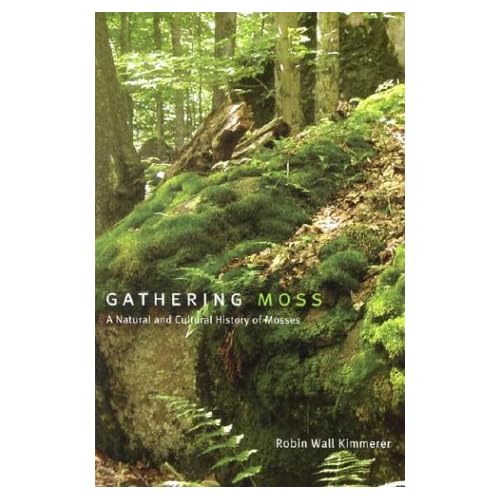
Gathering Moss is an artful blend of natural history for the non-specialist, personal narrative, and cultural reflection. The voice on the page is at once byrologist, mother, teacher, and writer of Potawatomi heritage, sharing her insights of how careful study of the simple lives of mosses bear lessons for how to live in the world.
In an early chapter, she describes the effort her biology students put into learning the ornate Latin names of mosses (of course, being so easily overlooked, most mosses lack a common name). But learning the names of species and their parts, Kimmerer points out, has its rewards.
"Having words for these forms makes the differences between them so much more obvious. With words at your disposal, you can see more clearly. Finding the words is another step in learning to see."LANGUAGE as a way of SEEING! It's true. Yesterday, seasonable weather returned, making this a cool and rainy weekend in northern Vermont. A good time to forage for some spring edibles! Out in a drizzle with friends hunting fiddleheads, I was guided by the fact that I was looking not for just any young fern's curled fronds but for those of the ostrich fern (matteuccia struthiopteris), whose tall vertical stalks feather out in fronds resembling the feathers of an ostrich. Equipped with this knowledge, the brown feather-like remains of last year's stalks became easy to spy along the river bank (even from the roadside as we drove). At the base of each I found what I was looking for-- numerous fat, green clumps of curled fronds, like the scrolls of violins. My friends and I gathered a small bagful each, and I later sauteed them in a bit of olive oil and diced ramps (wild leeks) that we had foraged elsewhere yesterday. Knowing what to look for (by name)--this kind of seeing can be delicious.
Sunday, April 15, 2012
Sven Birkerts on Emerson and "The Poet"
I just finished reading a wonderful little essay by Sven Birkerts about Emerson's "The Poet" and its continued importance in our culture and creative lives. Here's a snippet of it. The full text can be found here.
"For, the experience of each new age requires a new confession, and the world seems always waiting for its poet."
How does the poet, the serious poet, navigate what has become the inescapable porousness, the basic destruction of the boundary of the private? Is the full and authentic lyric poem possible, or is it condemned to being a nostalgic gesture—with part of its impact derived from that fact?
"For, the experience of each new age requires a new confession, and the world seems always waiting for its poet."
***
It will be necessary to keep the sentiment but broaden the reference. That the world seems always waiting
seems incontestable, the feeling of waiting is everywhere—it is, I
think, what makes us ever more deeply enslaved to our devices: we are
glued to our screens of all sizes not for amusement or business, but
because we think something is going to be announced. We can’t bear to
miss it. But that something is not poetry, unless we give poetry an
apocalyptic possibility. We are on the run from the anxious vibration of
our living, caused in part by the sense that things are more connected
than ever and that it’s the whole world that is somehow pressing in on
us, “obsessing our private lives,” as Auden wrote, though the nature of
those private lives has changed a great deal since that writing. It
could almost be argued that we no longer have private lives, and that
that lack, and the porousness that it implies, is the cause of our
unease, is what underlies that waiting. We are waiting for something
that will feel like a solution when it arrives; we are waiting for the
oppression of “what’s next?” to be lifted. We are, in a deeper sense,
waiting for our poet. But we are not waiting for the poem so much as the
permission to certify ourselves, to inhabit the world on terms we
understand, to be free of the feeling that everything is being decided
elsewhere. The poet, then, is the emblem of self-sufficiency, and the
poem, could we only find our way to it and understand it, is his proof.
The poem of our age, the new confession, would find a way to shape the
ambient energies and the anxiety of that interconnectedness into an
expression that felt contained, that gathered the edgy intuitions that
pass through us constantly and made them feel like understandings. Not
closed off or insistent understandings, but clarifications, ways of
abiding with the terrifying glut of signals. Moving that agitated flurry
into language is no small task. It might even be impossible, given that
the nature of most of these signals is pre- or post-verbal. Emerson’s
assertion becomes a question, the question: can anyone, poet or
artist or mere lay mortal, create a confession—an expression, a
synthesis—that would alleviate the waiting world? Or have we moved once
and for all beyond the pale of synthesis—with only partial versions
possible? Another way of asking whether our circumstance is now beyond
the reach of vision. Beyond language.How does the poet, the serious poet, navigate what has become the inescapable porousness, the basic destruction of the boundary of the private? Is the full and authentic lyric poem possible, or is it condemned to being a nostalgic gesture—with part of its impact derived from that fact?
Tuesday, April 3, 2012
I've been away from this blog for a while now, mostly due to a drive to finish a few poems ahead of the Monsters reading last week in Madison and an overload of recent stimuli from out in the real world--notably the trip itself, which found me in a full-bloom Wisconsin spring (weeks ahead of us in northern Vermont) among friends and loved ones, while also finally getting into some of the deep waters of crazy Ahab chapters in Moby-Dick, picking up a fabulous novel (Learning to Pray in the Age of Technique) by the young Portugese luminary Goncalo Tavares, listening to Sharon Van Etten's new album Tramp, and absolutely obsessing over David Milch's latest accomplishment, the HBO series Luck, which was prematurely canceled due to tragic misfortune.
Sometime this week I hope to gather my thoughts and post something about Milch's Luck. Not a review, so much as a few thoughts on, among other things, the way its portrayal of horses is beautiful and moving and reminds me of the terribly gentle encounter the Pequod's killers have with the calm center of a pod of whales in "The Grand Armada" chapter.
In case you haven't seen Luck or think a series only 9 episodes long, whose entire cast and crew only learned of its cancellation after completing the penultimate episode, can't achieve something artistically important, please do yourself the pleasure of watching it. I spent last weekend doing not much else and feel richly rewarded for it. Seriously.
Thursday, March 15, 2012

Wednesday, March 14, 2012
Goldman Suchs
Kudos to Greg Smith, who resigned from Wall Street giant and Great Recession architects Goldman Sachs today and left with a parting cannon shot in the form of a New York Times Op-Ed piece. You can read Smith's rare, bold take-down here.
I would say this is unrelated to poetry, except that it touches on a conversation Baron Wormser and I had a few nights ago after his reading at VSC. We were discussing social responsibility in poetry and its difficulty, given American poetry's long-time obsession with the self and what a fine, mature, responsible poet we did have in William Matthews. At one point, Baron suggested we need more naming of names, especially when they are our own, an outing of the forces of evil (or at least life-crushing interests) in our poetry. Look at the Polish and Russian poets who took on the regimes of the 20th century head-on. Where does such poetry exist in the United States? Could it?
So kudos again to Mr. Smith, who is stepping down as executive director of Godman Sachs and laying that company's wastrel and corrupt culture at the feet of that smirking schmuck Lloyd Blankfein and his crony, Gary Cohn.
Tuesday, March 13, 2012
Reckoner (take three)

Reckoner
Since we uploaded into the cloud
the earth misses us the ground
It hasn’t rained for months
The sleek new skins of our hand-
held devices flash menacingly calm
like the pearl blank face of the water
::
We go down to the lake
and bathe in its shades: gin clear
fluorescent grey
All our campfire girls
All our drowned fuselages and kelped wrecks
All our pine pollen soft parades
Our mouthfuls and gulped breaths
How many gigabytes is that?
::
Sometimes we float, bumping along
shoulder to shoulder in the screensaver
blue in a simulacrum of friendship
If we’re not in the lake
where are we?
Seen and unseen
like a Ghost Man on second
like a child worker in China
::
Sometimes we float in it almost
bodiless lost in the flickering
voices that will not save us
Even with value added
The pony-tailed technician
who assembled and wiped
to a loving sheen
our delicately cheap touchscreens
her little hands are ruined
by the solvents
by the robotic maneuvers
so we can share
with smudgeless clarity
She doesn’t even know
how to swim
::
Teenaged girls drop from factory eaves
like spiraled cones raining
from pine boughs
in a sudden gust
Circles touching circles
spreading
across faces
We take and we take and
we tag
::
On the lakeshore a mother mallard
nestles into needles to make her
home above rocks
where a boy with a stick
is sure to find her
Where is your warm hand
for my hand?
Subscribe to:
Posts (Atom)